---
title: The T-Shaped TA Leader
description: I used to produce a conference where I'd bring technology execs to our stage to talk to us about the work they're doing, the kind of talent they needed, and the future of technology.
image: https://blog.recruitingtoolbox.com/hubfs/t%20shape%20image%20blog.jfif
---
[](https://recruitingtoolbox.com/)
- [Training](https://recruitingtoolbox.com/training/)
- CUSTOM-BUILT TRAINING FOR RECRUITERS & RECRUITING MANAGERS
- [Overview](https://recruitingtoolbox.com/training/)
- [Talent Advisor Training POPULAR](https://recruitingtoolbox.com/training/talent-advisor-training/)
- [Recruiting Leadership Training](https://recruitingtoolbox.com/training/recruiting-leadership-training/)
- [Diversity Recruiting Training](https://recruitingtoolbox.com/training/diversity-recruiting-training/)
- [Selling and Closing Training](https://recruitingtoolbox.com/training/selling-closing-training/)
- [Online Recruiter Academy](https://recruitingtoolbox.com/training/online-recruiter-training/)
- [Recruiting Leadership Labs (Managers Only)](https://labs.recruitingtoolbox.com/)
- [Recruiting Leadership Lab 50 (Sr Director/VPs Only)](https://labs.recruitingtoolbox.com/rll50/)
- CUSTOM-BUILT TRAINING FOR HIRING MANAGERS & INTERVIEWERS
- [Interviewer / Hiring Manager Training POPULAR](https://recruitingtoolbox.com/training/interviewer-training/)
- [Overview](https://recruitingtoolbox.com/training-for-hiring-managers/)
- [License to Hire Training](https://recruitingtoolbox.com/training/license-to-hire-training/)
- [Hiring Manager Diversity Training](https://recruitingtoolbox.com/training/hiring-manager-diversity-training/)
- [Executive Hiring Manager Training](https://recruitingtoolbox.com/training/executive-hiring-manager-training/)
- [Bar Raiser Training](https://go.recruitingtoolbox.com/bar-raiser-training-overview)
- [Online Interviewer & Hiring Manager Training](https://recruitingtoolbox.com/training/online-interviewer-training/)
- FREE TRAINING
- [Recorded Webinars and Conference Presentations](https://recruitingtoolbox.com/training/free-best-practices-webinar-videos/)
- [Consulting](https://recruitingtoolbox.com/consulting/)
- REAL-WORLD CONSULTING SERVICES
- [Learn more about our experienced consultants](https://recruitingtoolbox.com/about-us/team/)
- STRATEGY & PROCESS CONSULTING
- [Strategy, Org Model, and Process Consulting POPULAR](https://recruitingtoolbox.com/consulting/#strategy)
- [Coaching for Talent Leaders](https://recruitingtoolbox.com/consulting/#CoachingforTalentLeaders)
- [EVP, Employment Branding, and Messaging](https://recruitingtoolbox.com/consulting/#evp)
- [Hiring Manager Self-Service Toolbox](https://recruitingtoolbox.com/consulting/#hiring-manager)
- HIRING BAR CONSULTING
- [Hiring Standards and Interview Guides POPULAR](https://recruitingtoolbox.com/consulting/#hiring)
- [Bar-Raisers and Quality Control Mechanisms](https://recruitingtoolbox.com/consulting/#bar-raisers)
- [Resources](https://recruitingtoolbox.com/resources/)
- BECOME AN EXPERT
- [How to Be a Talent Advisor](https://recruitingtoolbox.com/resources/how-to-be-a-talent-advisor/)
- [How to Be an Effective Recruiting Leader](https://recruitingtoolbox.com/resources/how-to-be-an-effective-recruiting-leader/)
- [How to Leverage Bar Raisers](https://recruitingtoolbox.com/resources/bar-raisers/)
- FREE RECRUITING BEST PRACTICES
- [Our Resource Library](https://recruitingtoolbox.com/resources/)
- [Recruiting Toolbox Blog](https://blog.recruitingtoolbox.com/blog)
- [Recorded Webinars and Conference Presentations](https://recruitingtoolbox.com/training/free-best-practices-webinar-videos/)
- [Event Attendee Downloads](https://recruitingtoolbox.com/resources/event-downloads/)
- STUFF WE LOVE
- [Bookstore and Stickers](https://recruitingtoolbox.com/store/)
- [Clients](https://recruitingtoolbox.com/clients/)
- CLIENTS
- [Who hires us?](https://recruitingtoolbox.com/clients/)
- TESTIMONIALS
- [Client Testimonials](https://recruitingtoolbox.com/clients/testimonials/)
- [ARE YOU A SOLO RECRUITER, AGENCY, OR PART OF A SMALL TEAM?](https://staging.recruitingtoolbox.com/clients/solo-recruiters-agencies-small-teams/)
- [How We Support Small Recruiting Teams](https://recruitingtoolbox.com/clients/solo-recruiters-agencies-small-teams/)
- [About Us](https://recruitingtoolbox.com/about-us/)
- WHAT WE DO
- [How We Help Companies Recruit Better](https://recruitingtoolbox.com/about-us/)
- WHY CHOOSE US
- [Why Companies Hire Us](https://recruitingtoolbox.com/about-us/why/)
- OUR TEAM
- [Meet Our Team](https://recruitingtoolbox.com/about-us/team/)
- [Connect With Us](https://recruitingtoolbox.com/about-us/connect-with-us/)
- [Ask Us to Speak at Your Event](https://recruitingtoolbox.com/speaking-engagements/)
- [Contact](https://recruitingtoolbox.com/contact/)
- [Training](https://recruitingtoolbox.com/training/)
- CUSTOM-BUILT TRAINING FOR RECRUITERS & RECRUITING MANAGERS
- [Overview](https://recruitingtoolbox.com/training/)
- [Talent Advisor Training POPULAR](https://recruitingtoolbox.com/training/talent-advisor-training/)
- [Recruiting Leadership Training](https://recruitingtoolbox.com/training/recruiting-leadership-training/)
- [Diversity Recruiting Training](https://recruitingtoolbox.com/training/diversity-recruiting-training/)
- [Selling and Closing Training](https://recruitingtoolbox.com/training/selling-closing-training/)
- [Online Recruiter Academy](https://recruitingtoolbox.com/training/online-recruiter-training/)
- [Recruiting Leadership Labs (Managers Only)](https://labs.recruitingtoolbox.com/)
- [Recruiting Leadership Lab 50 (Sr Director/VPs Only)](https://labs.recruitingtoolbox.com/rll50/)
- CUSTOM-BUILT TRAINING FOR HIRING MANAGERS & INTERVIEWERS
- [Interviewer / Hiring Manager Training POPULAR](https://recruitingtoolbox.com/training/interviewer-training/)
- [Overview](https://recruitingtoolbox.com/training-for-hiring-managers/)
- [License to Hire Training](https://recruitingtoolbox.com/training/license-to-hire-training/)
- [Hiring Manager Diversity Training](https://recruitingtoolbox.com/training/hiring-manager-diversity-training/)
- [Executive Hiring Manager Training](https://recruitingtoolbox.com/training/executive-hiring-manager-training/)
- [Bar Raiser Training](https://go.recruitingtoolbox.com/bar-raiser-training-overview)
- [Online Interviewer & Hiring Manager Training](https://recruitingtoolbox.com/training/online-interviewer-training/)
- FREE TRAINING
- [Recorded Webinars and Conference Presentations](https://recruitingtoolbox.com/training/free-best-practices-webinar-videos/)
- [Consulting](https://recruitingtoolbox.com/consulting/)
- REAL-WORLD CONSULTING SERVICES
- [Learn more about our experienced consultants](https://recruitingtoolbox.com/about-us/team/)
- STRATEGY & PROCESS CONSULTING
- [Strategy, Org Model, and Process Consulting POPULAR](https://recruitingtoolbox.com/consulting/#strategy)
- [Coaching for Talent Leaders](https://recruitingtoolbox.com/consulting/#CoachingforTalentLeaders)
- [EVP, Employment Branding, and Messaging](https://recruitingtoolbox.com/consulting/#evp)
- [Hiring Manager Self-Service Toolbox](https://recruitingtoolbox.com/consulting/#hiring-manager)
- HIRING BAR CONSULTING
- [Hiring Standards and Interview Guides POPULAR](https://recruitingtoolbox.com/consulting/#hiring)
- [Bar-Raisers and Quality Control Mechanisms](https://recruitingtoolbox.com/consulting/#bar-raisers)
- [Resources](https://recruitingtoolbox.com/resources/)
- BECOME AN EXPERT
- [How to Be a Talent Advisor](https://recruitingtoolbox.com/resources/how-to-be-a-talent-advisor/)
- [How to Be an Effective Recruiting Leader](https://recruitingtoolbox.com/resources/how-to-be-an-effective-recruiting-leader/)
- [How to Leverage Bar Raisers](https://recruitingtoolbox.com/resources/bar-raisers/)
- FREE RECRUITING BEST PRACTICES
- [Our Resource Library](https://recruitingtoolbox.com/resources/)
- [Recruiting Toolbox Blog](https://blog.recruitingtoolbox.com/blog)
- [Recorded Webinars and Conference Presentations](https://recruitingtoolbox.com/training/free-best-practices-webinar-videos/)
- [Event Attendee Downloads](https://recruitingtoolbox.com/resources/event-downloads/)
- STUFF WE LOVE
- [Bookstore and Stickers](https://recruitingtoolbox.com/store/)
- [Clients](https://recruitingtoolbox.com/clients/)
- CLIENTS
- [Who hires us?](https://recruitingtoolbox.com/clients/)
- TESTIMONIALS
- [Client Testimonials](https://recruitingtoolbox.com/clients/testimonials/)
- [ARE YOU A SOLO RECRUITER, AGENCY, OR PART OF A SMALL TEAM?](https://staging.recruitingtoolbox.com/clients/solo-recruiters-agencies-small-teams/)
- [How We Support Small Recruiting Teams](https://recruitingtoolbox.com/clients/solo-recruiters-agencies-small-teams/)
- [About Us](https://recruitingtoolbox.com/about-us/)
- WHAT WE DO
- [How We Help Companies Recruit Better](https://recruitingtoolbox.com/about-us/)
- WHY CHOOSE US
- [Why Companies Hire Us](https://recruitingtoolbox.com/about-us/why/)
- OUR TEAM
- [Meet Our Team](https://recruitingtoolbox.com/about-us/team/)
- [Connect With Us](https://recruitingtoolbox.com/about-us/connect-with-us/)
- [Ask Us to Speak at Your Event](https://recruitingtoolbox.com/speaking-engagements/)
- [Contact](https://recruitingtoolbox.com/contact/)
# Recruiting Toolbox Blog
# The T-Shaped TA Leader
[John Vlastelica](https://blog.recruitingtoolbox.com/blog/author/john-vlastelica)
April 15, 2026
2 minute read
This post first appeared on John’s [Try Harder is Not a Strategy LinkedIn Newsletter.](https://www.linkedin.com/pulse/t-shaped-ta-leader-john-vlastelica-ma0qc/?trackingId=HcKlUbSCTHqxxKq2RWZG3w%3D%3D)
I used to produce a conference - Talent42 - where I'd bring technology execs to our stage to talk to us (tech recruiters and TA leaders) about the work they're doing, the kind of talent they needed, and the future of technology. I wanted to help all of us lead more credible conversations with tech execs, so I was trying to build out more business and tech acumen, which is key to operating as a [talent advisor](https://recruitingtoolbox.com/resources/how-to-be-a-talent-advisor/).
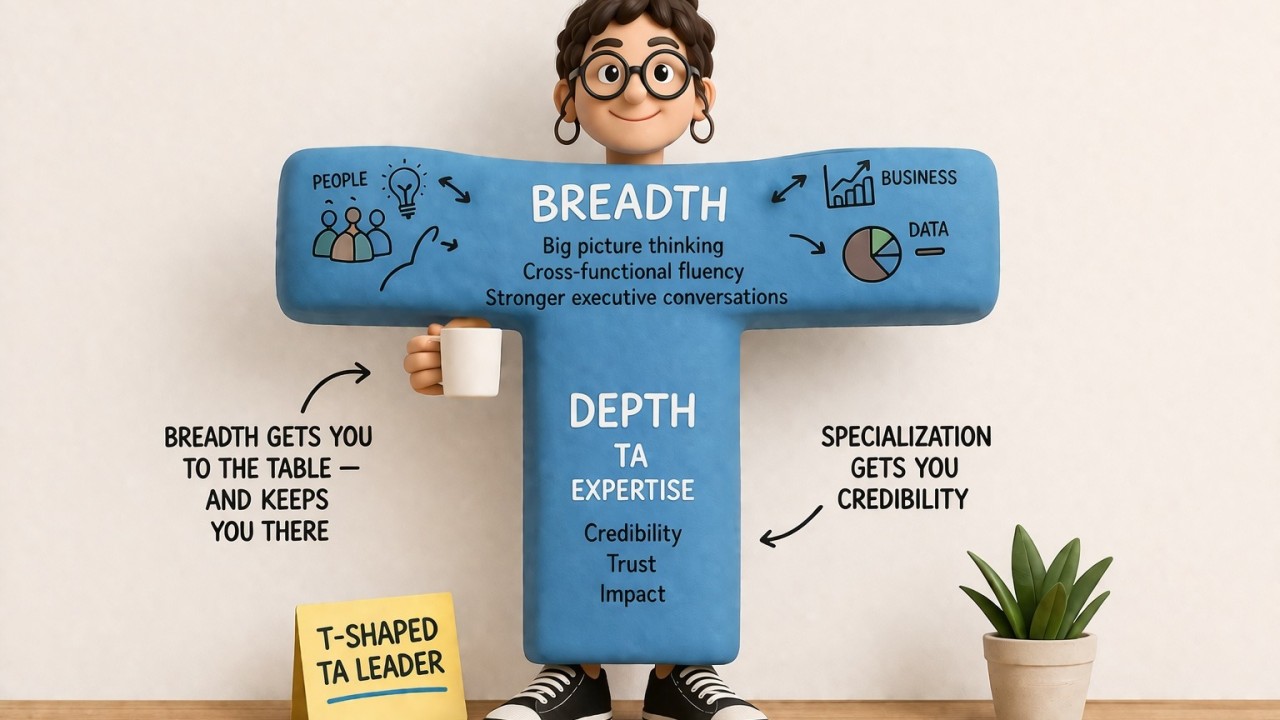
Back in 2015, we invited the tech leader charged with transforming Target (F500 retailer) into a powerhouse tech company to our stage (he somewhat jokingly told me he was trying to create Silicon Prairie in Minnesota, where they're HQ'd). I asked him to talk a bit about what makes a great engineer and engineering leader great. One of the things he emphasized was the T-shaped employee. Someone with both breadth and depth.
I've been involved in 100+ conversations with business execs about the kind of talent they need 2-3 years from now, and I regularly asked them about the mix of specialists vs generalists they'd want on their teams. The savviest leaders seemed to recognize the need for breadth of experience and exposure AND depth, with expertise in a few key areas. This was for all roles on their team - not just tech folks. Embedded in the need for generalist breadth was an underlying competency of demonstrated ability to learn new things quickly, know what you don't know, and adapt to the needs of the business.
> T-shaped employees give business leaders more flexible org capabilities, with the ability to hire somewhat fungible people they could move to different projects or roles as needed.
Those conversations are shaping how I think about what it means to be a great recruiter and TA leader in 2026 and beyond. We've always needed strong business acumen ([curiosity is key!](https://blog.recruitingtoolbox.com/blog/why-curiosity-might-be-the-most-important-skill-for-recruiters)), and while some of us - me included - specialized for some of our career, it's the broader knowledge of how all the pieces fit together that often leads to vertical and horizontal and diagonal career growth.
I've written a lot about how the demand from executives for more holistic talent conversations is [pushing today's Talent Advisor 1.0 to a 2.0 Talent Advisor/Talent Manager role](https://www.linkedin.com/pulse/defining-corporate-recruiter-role-2026-john-vlastelica-xnzwe/?trackingId=iHq8jC2aS%2FSG969qFsMcFQ%3D%3D). Execs want to partner with a TA team that understands more than just req needs, market realities, and how to sell the company. They want and need deeper discussions with more complex root issues.
Specialization is still important for some roles, for sure, but more and more, I predict we'll see the rise of the generalist in TA roles. If you're in TA today, specialization may get you the credibility to get the seat at the table, but once you're at the table, it'll be some of your more generalist breadth that'll get you invited to lead around more complex issues that require [holistic thinking](https://blog.recruitingtoolbox.com/blog/recruiting-toolboxs-john-vlastelica-leading-in-talent-acquisition) and adaptability.
I read this book - [Range](https://en.wikipedia.org/wiki/Range:_Why_Generalists_Triumph_in_a_Specialized_World) - years ago, about the need for generalists in a rapidly changing, complex world, and loved it. It's shaped my thinking when we work on projects to [help companies define "what good looks like"](https://recruitingtoolbox.com/consulting/#_hiring) ahead of interview training.
> In the book, the author argues that *range* – defined as more diverse experience across multiple fields – is more relevant in today's society than specialization because the wicked problems of the modern world require bridging experience and knowledge from multiple fields to foster solutions.
I think more and more best practices will be embedded into AI, [**so knowing recruitment best practices just won't be enough anymore**](https://www.linkedin.com/pulse/when-pushing-best-practices-isnt-enough-john-vlastelica-zsiyc/?trackingId=%2FKt9pR8QQv2Jt%2BF35ycbkg%3D%3D).
My question for you: What kind of breadth do you think a TA professional needs to develop in 2026+ and what kind of specialization is still needed? Please share in the comments section.
© Recruiting Toolbox, Inc.
No duplication or re-posting without express written permission of Recruiting Toolbox, Inc. - contact us at [www.RecruitingToolbox.com/Contact](http://www.recruitingtoolbox.com/Contact)
[Talent Advising](https://blog.recruitingtoolbox.com/blog/tag/talent-advising)
## You might also be interested in...
#### [Why You Need a Company-Wide Point of View on Candidate Cheating](https://blog.recruitingtoolbox.com/blog/candidate-cheating)
#### [Will AI Replace Junior Roles?](https://blog.recruitingtoolbox.com/blog/will-ai-replace-junior-roles)
#### [How to not suck when leading work to change recruiter role expectations](https://blog.recruitingtoolbox.com/blog/how-to-not-suck-when-leading-work-to-change-recruiter-role-expectations)
## About Recruiting Toolbox
Recruiting Toolbox, Inc. is a specialized management consulting and training firm that helps [companies](https://recruitingtoolbox.com/clients/) recruit better, from startups to world-class brands. Our [consultants](https://recruitingtoolbox.com/about-us/team/) – all former corporate talent leaders – partner with you – heads of recruitment and HR – to improve speed, hire quality, candidate experience, and diversity hiring ROI. And it’s all tailored to your talent goals, culture, budget, and resource model.
We work with clients across the globe – 20 countries so far – from our offices in the US.
## Popular Training Programs
- [Talent Advisor Recruiter Training](https://recruitingtoolbox.com/training/talent-advisor-training/)
- [Recruiting Leadership Lab](https://labs.recruitingtoolbox.com/)
- [RLL50 (Heads of TA)](https://labs.recruitingtoolbox.com/rll50/)
- [Interviewer / Hiring Manager Training](https://recruitingtoolbox.com/training/interviewer-training/)
- [Online Hiring Manager Training](https://recruitingtoolbox.com/training/online-interviewer-training/)
## Best Practices
- [What is a Talent Advisor?](https://recruitingtoolbox.com/what-is-a-talent-advisor/)
- [How to be a Talent Advisor](https://recruitingtoolbox.com/resources/how-to-be-a-talent-advisor/)
- [Talent Advisor Diagnostic Tool](https://go.recruitingtoolbox.com/talent-advisor-diagnostic-tool)
- [Hiring Manager Maturity Model](https://go.recruitingtoolbox.com/downloads/white-papers-best-practices/the-hiring-manager-maturity-model)
- [Interviewing Diagnostic Tool](https://go.recruitingtoolbox.com/interviewing-effectiveness-diagnostic-tool)
## Contact Us
Interested in learning how we can help your teams recruit better? [Contact us](https://recruitingtoolbox.com/contact/).
Want access to more best practices? Like us on [Facebook](https://www.facebook.com/recruitingtoolbox), follow us on [Twitter](https://twitter.com/RecruitToolbox), and follow us on [LinkedIn](https://www.linkedin.com/company/recruiting-toolbox-inc./). Subscribe to our [blog](https://recruitingtoolbox.com/blog-signup/) to receive best practices in your inbox a few times per month.
© Recruiting Toolbox, Inc | All Rights Reserved | [Privacy](https://recruitingtoolbox.com/privacy/)