This post first appeared on John’s Try Harder is Not a Strategy LinkedIn Newsletter.
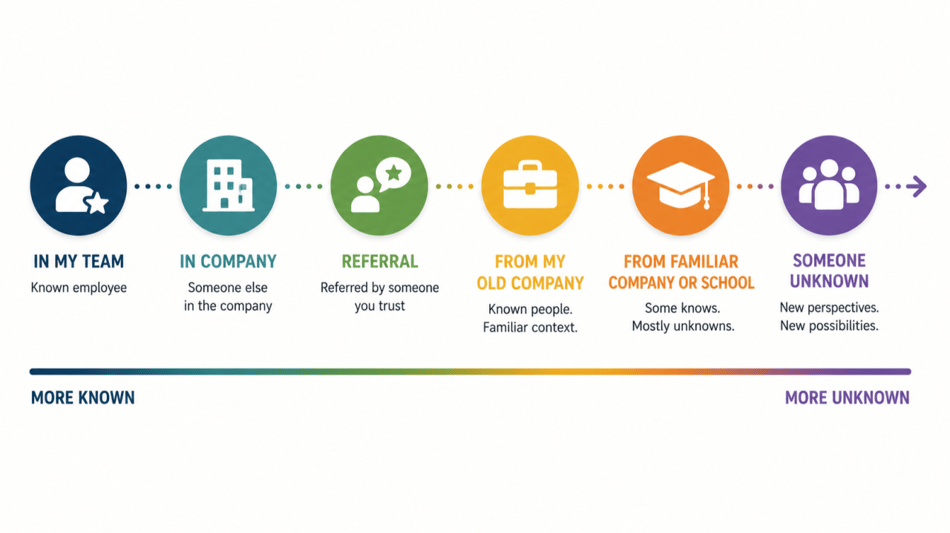
Hiring managers have depended on proxies for quality since I began recruiting the late 20th century :)
On some level, it makes complete sense. Known candidates feel less risky and more predictable to many hiring managers than unknown candidates. And if the economy is such that your job opening gets a lot of inbound talent from well known companies and schools, why not prioritize the "known" talent first? That rationale says you should start by hiring from your own company, from referrals, and from well respected companies and schools before you talk to a "stranger."
I don't think this has changed much during my career. In fact, many recruiters - and now AI? - still depend a lot on proxies when trying to align on the ideal candidate profile. (I don't think there should be just one ideal candidates, by the way.)
But I want to dig into a bit of the WHY for proxies a bit more, as I think it's not just because they feel like a safer, more predictable bet.
I think many hiring teams struggle to evaluate talent effectively. They have their favorite interview questions, their interview intelligence note-taking AI tools, their HR generated or AI generated interview guides, and their rubrics. But many interviewers and hiring managers have not done the hard work to align on what good looks like - they have the questions, but not the answers, especially if the kind of talent they need in 2026 looks different than 4-5 years ago, when many of their copy-pasted job descriptions were first created.
Also, many interviewers don't know how to predict success well, even after behavioral interview training that shares quality questions that are designed to surface evidence of performance. While I'm impressed by the AI-generated interview guides (if prompted effectively, AI can generate incredibly good behavioral interview questions for any role), many interviewers and recruiters still think asking good questions is what makes a great interviewer great. It's not. What makes great interviewers able to predict success better than flipping a coin is running a rigorous evidence-seeking interview, with time and expertise to evaluate the candidate and translate what they did in their past and can do now during the interview into the real needs of the job. And then come together as an interview team, and trust that everyone went deep in their focus areas, to get a more complete picture of the candidate's skills, behaviors, motivators, and achievements.
So now we go full circle. Because too many interviewers and hiring managers lack that rigor and don't have Talent Advisor recruiters guiding them, coaching them, inspecting their interview questions, facilitating their hiring decisions, giving feedback on their interview feedback, and helping them improve, they end up going for known over unknown. Essentially, they put a lot of weight into the proxies for quality vs getting their own evidence of quality from the interview.
Have we outsourced recruiting and interviewing to proxies? Meaning, are hiring managers who will ONLY hire from certain companies and schools pursuing only those candidates because they don't know how to interview effectively? As TA leaders, we need to explore this with our recruiting and hiring teams.
Of course, I'm not suggesting that someone who worked at a big brand company or went to a top rated university or came in as a strong referral won't be great. But there's too much trust being placed in the source, and not enough in the actual evaluation of the candidate. And now that candidates can optimize their resumes to exactly match the job description's requirements, it's more important than ever that our interviewers can actually interview and select the right talent for their orgs. And many of their orgs are transforming, so to compound this problem, the kinds of interview questions and focus areas they built competence around might actually be different now in 2026.
The move from to more unknown talent:
- Considering unknown talent requires better interviewing and selection skills.
- Focusing on more unknown talent also expands the size of the talent pool.
- And that new talent pool may be more affordable, as well.
It's key that we as Talent Advisors understand the root issues that keep our teams from considering certain talent pools. Often, the key to improving speed is alignment on what good looks like + finding super interested, affordable talent that's not getting pinged 100 times a day by recruiters and hiring managers from better known, better paying people competitors.
I think the future role of the recruiter will focus 50% more on candidate assessment. Not just personally assessing talent (especially because of fraud and identical looking resumes), but being a true expert guide and coach to the hiring managers and interviewers around how THEY can better predict success.
This is going to be a big shift. Most recruiters haven't played much more than a note taker role in hiring decision meetings. It's time we step up. And we need to step up earlier - at the kickoff meeting, where hiring managers are trying to mitigate risk by only wanting to see talent from known sources.
If we don't increase their evaluation capabilities, they will likely continue to push to see talent only from certain companies and certain schools.
Questions for you:
- Are you getting so much inbound quality talent that you haven't had to push back on HMs who only want ideal profile candidates from certain companies and schools?
- If you are trying to move them from known to unknown (bigger talent pools, more affordable talent pools), how are you doing that?
- Do you have a plan in place to get your hiring teams better skilled at candidate evaluation?
- And how has your role evolved as candidate assessment expert at your org? What are you doing now that you didn't do 2-3 years ago?
© Recruiting Toolbox, Inc.
No duplication or re-posting without express written permission of Recruiting Toolbox, Inc. - contact us at www.RecruitingToolbox.com/